#4 – 20133 102nd Avenue, Langley, B.C. V1M 4B4 Canada

#4 – 20133 102nd Avenue, Langley, B.C. V1M 4B4 Canada
Choosing the right Anchor Drilling Machine in 2026 requires more than comparing engine power or purchase price. Global buyers face different ground conditions, project scales, transport limits, and service capabilities. A compact crawler rig may suit restricted urban sites, while a high-torque rotary machine may perform better in fractured rock. Soil changes quickly. Specifications must meet reality.
Dr. Evert Hoek, a respected rock-engineering expert, has stressed, “The properties of a rock mass are not the same as those of intact rock.” This principle should guide every equipment decision. Buyers should examine drilling diameter, torque, feed force, flushing capacity, mast reach, rod handling, and anchoring depth. A machine designed for soft soil may struggle against hard limestone. Another model may offer impressive power but consume excessive fuel during long shifts.
Field experience also exposes less visible concerns. Operators need clear controls, stable platforms, accessible maintenance points, and dependable spare parts. Local technicians matter. So does training. A reliable Anchor Drilling Machine should remain productive after dust enters the site and weather changes suddenly. That is not guaranteed.
This guide compares crawler, truck-mounted, pneumatic, hydraulic, and rotary-percussive types for international applications. It considers foundation anchors, slope stabilization, mining support, and infrastructure work. Environmental limits and regional safety requirements also deserve attention. Buyers sometimes focus too heavily on capacity figures. That choice can become expensive.
No machine wins every site. The best selection balances geology, mobility, productivity, maintenance, and total ownership cost. Some recommendations may remain uncertain without a proper site investigation. That limitation matters. Good engineering accepts uncertainty, measures it carefully, and avoids promises that equipment alone cannot keep.
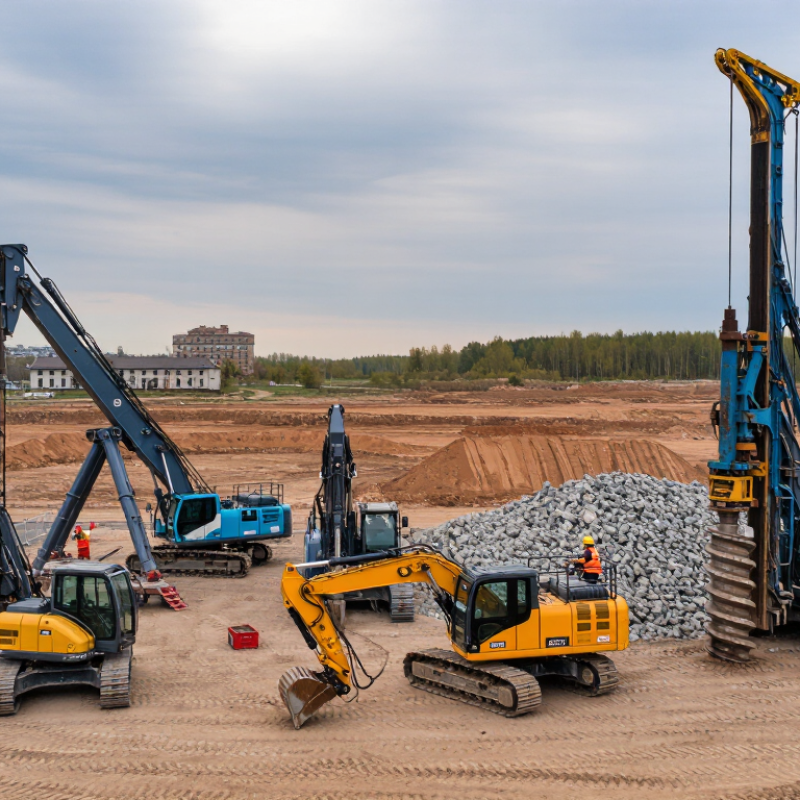
Anchor drilling machines are specialized rigs that create holes for ground anchors, rock bolts, micropiles, and slope stabilization systems. They transfer drilling energy through a rotary head, down-the-hole hammer, or hydraulic percussion tool. Their purpose is practical: secure unstable soil, retain excavation walls, and improve foundation resistance.
A typical machine includes a crawler or truck chassis, mast, feed beam, rotary head, drilling rods, compressor, hydraulic power pack, and grout pump. The control panel regulates rotation, thrust, torque, and drilling speed. Water or air removes cuttings, while grout bonds the anchor to surrounding ground. The Federal Highway Administration’s Ground Anchors and Anchored Systems handbook identifies the fixed length, free length, and anchorage as core anchor zones. That distinction matters during machine selection. It is often overlooked.
Market demand also reflects wider construction activity. MarketsandMarkets’ 2024 Construction Equipment Market report estimates growth from about USD 250 billion in 2023 to more than USD 300 billion by 2028. However, market size does not prove drilling quality. Ground conditions decide more than sales forecasts.
Experienced contractors match machine torque and feed force with rock hardness, hole diameter, and required depth. A compact crawler may suit restricted sites. A larger rig may deliver better productivity in open terrain. Yet larger is not always better. Noise, access, dust control, and rod handling can change the real output. EN 1537:2013 and FHWA guidance both emphasize execution control, testing, and grouting quality. The machine is only one part of the system. Misreading that point remains an expensive mistake.
Anchor drilling machines must match the ground, not merely the project budget. In clay, silt, and weathered soil, hydraulic rotary rigs provide steady torque and controlled flushing. Their adjustable rotation suits soil anchors and micropiles. According to the FHWA Ground Anchors and Anchored Systems manual, borehole stability and grout performance strongly influence anchor reliability.
Loose sand and gravel require casing-advancement or duplex drilling systems. Casing supports unstable walls while drilling continues, especially near the water table. The USGS Mineral Commodity Summaries 2024 reported approximately 970 million metric tons of U.S. construction sand and gravel production in 2023. That volume reflects constant demand for dependable ground-support work, but material quality still varies sharply between sites.
Hard granite and competent limestone favor down-the-hole hammer rigs. Percussion energy breaks rock efficiently, while compressed air removes cuttings from deep holes. Top-hammer machines can work well in fractured rock and restricted spaces, although deviation may increase. Low-headroom rigs are useful beneath bridges, inside basements, and along narrow retaining walls. United Nations World Urbanization Prospects projects that 68% of people may live in urban areas by 2050, increasing demand for compact equipment.
A simple type chart is not enough. Groundwater, abrasiveness, access, and required hole angle can change the choice. I would not specify a rig from a soil label alone. A short investigation, trial bore, and drilling record often prevent expensive assumptions.
Choosing the best anchor drilling machine starts with the ground, not the catalog. Soil, fractured rock, access width, and anchor length determine the suitable machine type. A compact crawler rig works well on steep slopes and narrow construction sites. A truck-mounted rig offers faster relocation across large projects. Underground work may require a low-clearance machine with a short mast.
The drilling method must match the anchor application. Rotary drilling suits softer soil and stable formations. Down-the-hole drilling delivers stronger penetration in hard, abrasive rock. Top-hammer drilling can be practical for shorter holes and moderate rock conditions. For temporary slope anchors, accurate hole alignment and quick setup may matter most. Permanent anchors demand careful flushing, depth control, and reliable recording of drilling parameters. I have seen buyers choose high power first, then struggle with oversized machines and limited access.
Tips: Confirm the required hole diameter, depth, inclination, and anchor load before comparing machines. Ask for field data from similar ground conditions. Check compressor needs, rod handling, water use, transport limits, and operator visibility. A machine that performs well in dry granite may behave poorly in wet clay. That difference is easy to miss.
Do not rely on one specification sheet. Review service support, spare-part availability, operator training, and local safety requirements. A simple site trial can reveal vibration, mud removal, and positioning problems. The perfect match is rarely obvious. It should be tested against the actual ground, application, and working routine.
How to match machine type, drilling method, and anchor application by typical drilling diameter.
Handheld rotary hammers suit small concrete anchors, while top-hammer crawler rigs are commonly used for rock bolts and medium-diameter anchors. DTH and rotary-percussive rigs are better choices for deeper holes, hard rock, and larger ground-anchor systems. The diameter ranges are representative non-brand-specific field ranges; actual capacity depends on rock or concrete conditions, hole depth, rod size, compressor output, and anchor design.
In 2026, machine selection should begin with ground conditions, not catalog photos. The Global Wind Energy Council reported 117 GW of new wind capacity in 2023. That growth increases demand for reliable anchoring, foundation, and ground-improvement work. However, wind projects are only one application. Micropiles, slope stabilization, and temporary support require different drilling approaches.
Match the machine to the formation. Rotary systems suit softer soils and weathered rock. Down-the-hole systems usually perform better in hard rock, but they can increase air consumption and operating noise.
Consider torque, feed force, drilling diameter, maximum depth, and mast angle. Access also matters. A compact crawler may reach steep or confined sites, while a heavier rig can provide stronger feed stability. Fit matters.
Energy use deserves closer attention. The International Energy Agency’s World Energy Investment 2024 report estimated global clean-energy investment would exceed 2 trillion dollars in 2024. Buyers should therefore examine fuel consumption, electric options, dust control, and maintenance intervals.
Service documentation, spare-parts availability, operator training, and compliance with relevant safety standards can prevent costly downtime. Lowest purchase price is not always lowest cost. That remains easy to forget.
A practical weakness in many evaluations is overreliance on advertised depth, because real output changes with geology, tooling, weather, and operator skill. Require test data from comparable ground before approving the final machine.
2026 Best Anchor Drilling Machine Types for Global Buyers?
Crawler-mounted anchor drilling machines provide stable positioning on uneven ground. Truck-mounted units reduce relocation time between projects. Compact machines suit restricted urban sites, but their smaller frames may limit drilling depth.
Safety must guide the purchase. The International Labour Organization estimated 2.93 million work-related deaths and 395 million non-fatal injuries annually. Construction remains a high-risk sector. In 2023, the U.S. Bureau of Labor Statistics recorded 1,075 construction fatalities. These figures justify practical safeguards, not decorative paperwork. Buyers should verify emergency stops, guarding, pressure relief valves, visibility, and operator training. ISO 12100 supports machinery risk assessment, while the EN 16228 series addresses drilling and foundation equipment safety.
Maintenance records should include hose inspections, torque checks, mast alignment, and filter replacement intervals. Small hydraulic leaks can become serious on dusty sites. Transport planning also matters. Confirm machine width, axle loads, lifting points, and approved tie-down methods before shipment. EN 12195-1 can support cargo-securing calculations, but local road rules still control. Compliance may require conformity assessment, technical files, noise data, and regional electrical documentation. Requirements differ across markets.
One weakness remains. A complete checklist can hide poor field habits. Operators may bypass alarms when production pressure rises. Buyers should inspect real service access, spare-part availability, and training quality before signing. A machine that is safe only in ideal conditions is not truly safe.
| Machine Type | Best Applications | Typical Drilling Method | Typical Hole Diameter | Typical Drilling Depth | Key Safety Considerations | Maintenance Priorities | Transport and Site Requirements | Compliance Considerations for Global Buyers | Overall Suitability |
|---|---|---|---|---|---|---|---|---|---|
| Hydraulic Top-Hammer Anchor Rig | Soil nails, rock bolts, slope stabilization, foundation anchors, and general geotechnical work. | Percussive drilling with a hydraulic drifter mounted on a feed beam; air or water may be used for flushing. | Approximately 38–115 mm | Approximately 10–30 m per hole, depending on ground conditions and rod configuration | Guard rotating and reciprocating parts; control rod handling; manage airborne dust, noise, hydraulic pressure, and unexpected ground movement. Use emergency stops, hose restraints, and exclusion zones. | Inspect hydraulic hoses and fittings daily; lubricate the drifter and rod thread system; check feed-chain or cylinder wear, flushing lines, filters, and fasteners. | Crawler versions usually require a low-bed trailer or suitable site transporter. Confirm machine width, gross mass, loading angle, and ground-bearing capacity before mobilization. | Review machinery risk assessment requirements such as ISO 12100, guarding and control-system requirements such as ISO 13849-1 where applicable, and local rules for noise, dust, lifting, and pressure systems. | High versatility |
| Hydraulic Down-the-Hole (DTH) Anchor Rig | Hard rock, long rock anchors, micropiles, casing-assisted drilling, and projects requiring straight holes at greater depth. | A pneumatic hammer operates at the bottom of the hole; compressed air evacuates cuttings and powers the hammer. | Approximately 90–300 mm | Approximately 20–60 m or more, depending on tooling, casing, and geology | Control high-pressure compressed air, flying fragments, dust, noise, rod torque, and pressurized connections. Use whip checks, rated hoses, face protection, hearing protection, and dust suppression or extraction. | Service the air compressor and filters; inspect hammer components, drill bits, threaded joints, lubricators, air hoses, and casing shoes. Keep contaminants out of the air system. | Requires a compressor, drill rods, casing, and lifting equipment. Check axle loads, trailer capacity, compressor placement, ventilation, and access for long feeds. | Verify pressure-equipment and compressor requirements in the destination market. Apply relevant machinery, guarding, electrical, noise, dust-exposure, and occupational-safety regulations. | Best for hard rock |
| Rotary Anchor Drilling Rig | Soft to medium ground, hollow-stem or solid-stem drilling, grouting, micropiles, and applications where low-impact rotation is preferred. | Rotary or rotary-percussive drilling with augers, casing, tricone bits, or specialized anchor tooling. | Approximately 100–300 mm | Approximately 15–50 m, depending on tooling and formation stability | Prevent entanglement at the rotary head; secure rods and casing; control torque reaction, spoil discharge, grouting pressure, and unstable boreholes. Establish a clear swing and rotation zone. | Check rotary-head gearbox oil, chuck and thread condition, hydraulic filters, mast alignment, winch components, augers, and grout-pump wear parts. | Often transported on a crawler or trailer. Confirm overall height with the mast folded, transport width, machine center of gravity, and permissible road weight. | Confirm conformity assessment, operator controls, guarding, emissions, electrical systems, and local requirements for grouting and pressure injection. | Good for mixed soils |
| Crawler-Mounted Micropile and Anchor Rig | Restricted-access sites, retaining walls, basements, bridge works, underpinning, and steep or uneven terrain. | Rotary, rotary-percussive, or DTH drilling, normally using a compact mast and modular tooling. | Approximately 90–300 mm | Approximately 10–40 m, depending on mast length and rod handling | Verify stability on slopes and near excavations; use travel alarms, load charts, level indicators, crawler inspections, and controls against machine rollover or unexpected movement. | Inspect crawler chains, rollers, sprockets, travel motors, mast pins, hydraulic cylinders, leveling jacks, and structural welds. Remove mud from undercarriage components. | Crawler rigs improve site mobility but are not generally road legal without transport arrangements. Confirm folded dimensions, ramp capacity, tie-down points, and trailer loading procedure. | Check mobile-machinery rules, transport regulations, lifting and tie-down requirements, local excavation safety rules, and any requirements for work near public roads or utilities. | Best for access-limited sites |
| Compact Electric or Battery-Powered Anchor Rig | Indoor work, tunnels, urban renovation, low-emission projects, and sites where exhaust gases or noise must be minimized. | Electric-hydraulic rotary or top-hammer drilling; battery models use rechargeable industrial traction batteries. | Approximately 40–150 mm | Approximately 5–25 m, depending on model and tooling | Manage electrical isolation, battery charging, cable routing, ventilation, fire prevention, and stored hydraulic energy. Use suitable residual-current protection and lockout procedures. | Inspect power cables, connectors, cooling systems, battery condition, hydraulic oil, filters, chargers, and insulation. Follow the battery manufacturer’s service and storage limits. | Usually suitable for elevators, tunnels, and small access routes, but battery mass can be significant. Confirm doorway clearance, floor loading, turning radius, and charging access. | Check electrical safety, electromagnetic compatibility, battery transport and recycling rules, charger requirements, machine safety, and local fire-protection provisions. | Best for low-emission work |
| Handheld or Portable Anchor Drill | Light-duty rock bolts, short anchors, repair work, remote locations, and jobs where full-size rig access is impossible. | Hand-held rotary-percussive or pneumatic drilling with short rods and portable flushing equipment. | Approximately 25–75 mm | Typically up to 5–10 m per hole | Control manual reaction forces, vibration, silica dust, noise, falling rock, and awkward postures. Use a secondary support system where the operator cannot safely control the drill. | Inspect handles, chucks, trigger controls, air or power cables, lubrication points, bits, hoses, and vibration-damping components before each shift. | Easy to carry and ship, but requires a safe compressor or electrical supply and secure storage for rods, hoses, bits, and accessories. | Review occupational exposure limits for respirable crystalline silica and hand-arm vibration, as well as electrical, pneumatic, noise, and personal-protective-equipment requirements. | Best for small jobs |
| Multi-Function Anchor and Grouting Rig | Projects combining drilling, casing, anchor installation, cement grouting, jet grouting, or micropile construction. | Rotary or rotary-percussive drilling integrated with grout mixing, pumping, flushing, and optional casing systems. | Approximately 90–350 mm | Approximately 15–50 m, depending on configuration | Control multiple hazards simultaneously: rotating tools, grout injection pressure, cement exposure, hydraulic energy, suspended loads, and hose movement. Use pressure relief, guarding, and defined communication signals. | Flush grout lines after use; inspect pumps, valves, agitators, seals, pressure gauges, hydraulic systems, drilling tools, and wear liners. Prevent hardened grout from entering equipment. | Requires additional tanks, pumps, hoses, and consumables. Plan for higher payload, washout facilities, material handling, and separate transport of cement or additives. | Verify machinery safety, pressure-system controls, chemical and cement handling, environmental discharge rules, lifting provisions, and project-specific grouting specifications. | Best for integrated workflows |