#4 – 20133 102nd Avenue, Langley, B.C. V1M 4B4 Canada

#4 – 20133 102nd Avenue, Langley, B.C. V1M 4B4 Canada
A small magnet can hold a cabinet door, drive a loudspeaker, or help position a sensor. Yet choosing one for global procurement involves more than checking its pull force. Grade, shape, coating, temperature limits, and corrosion exposure all affect performance. A magnet that works well in a dry workshop may disappoint near salt spray or inside a hot motor.
The USGS Mineral Commodity Summaries 2025 reports estimated global rare-earth mine production of 390,000 metric tons in 2024, including 270,000 tons from China. These figures cover rare earths broadly, not neodymium magnets alone. They still show why buyers should check material origin, supplier documentation, and continuity of supply. David S. Abraham, author of The Elements of Power, captures a key sourcing challenge: “Rare earths are not rare, but they are rarely found in concentrated deposits.” The point matters. Mining supply does not automatically guarantee consistent magnet grades or finished-product availability.
This guide compares common Neodymium Magnet types for different purchasing needs, from discs and blocks to rings and custom shapes. It also considers N-grade options, protective coatings, and operating conditions. Ask for test data. Check the details. A catalog number is only a starting point. In practice, even a technically suitable magnet may require a sample test before a large order. That extra step takes time, but skipping it can cost more. No single type fits every application, and supplier claims deserve verification.
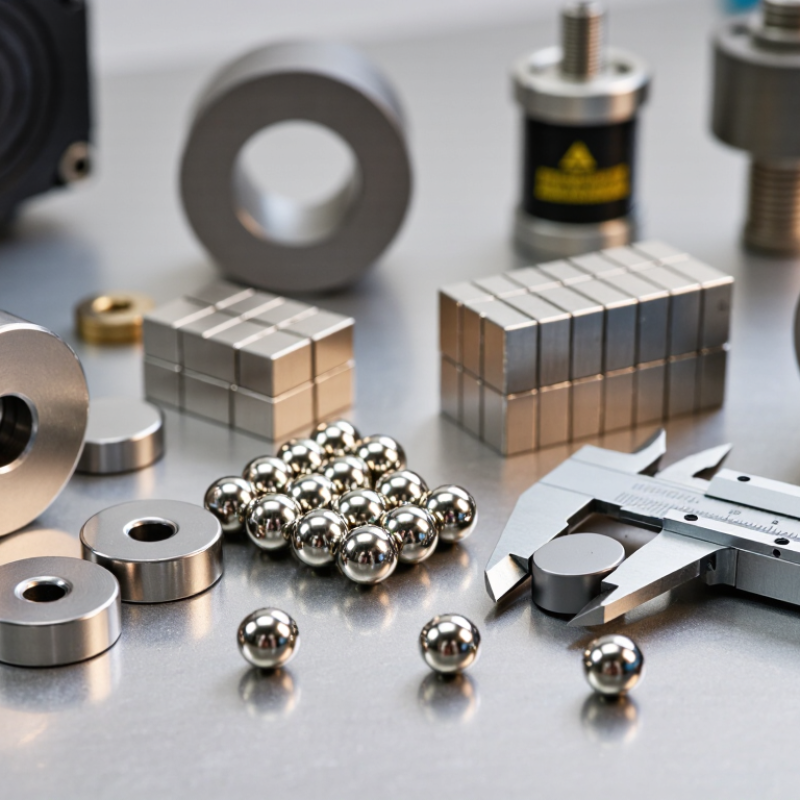
Neodymium magnets are sintered permanent magnets made mainly from neodymium, iron, and boron. Their strong magnetic field suits compact motors, sensors, and fixtures. The USGS Mineral Commodity Summaries 2025 estimates 2024 global rare-earth mine production at 390,000 metric tons of rare-earth-oxide equivalent, including 270,000 tons from China. These figures describe mined material, not finished magnets, so they should not be mistaken for magnet output.
Buyers commonly classify magnets by grade, shape, temperature rating, and coating. A grade such as N42 indicates a nominal maximum energy product of 42 megagauss-oersteds; it does not directly state holding force. A thin disc, block, or ring can perform differently because dimensions and the steel surface affect the magnetic circuit. Small, but important. Temperature suffixes indicate improved resistance to heat, though exact operating limits depend on the magnet and conditions.
Coatings help protect the iron-rich material from corrosion. Nickel-copper-nickel is common, but humid or chemically demanding settings may call for another finish. ASTM A977/A977M describes methods for measuring magnetic properties; buyers can request test data alongside a grade. A catalog code alone can mislead, and I would check working temperature and geometry before comparing prices.
A grade such as N35 or N52 describes a magnet’s maximum energy product, not a guaranteed pull force. N52 can deliver more magnetic energy in the same volume, but heat resistance and operating conditions still matter. A thin disk, a thick block, and a ring can behave differently in an assembly because geometry affects the magnetic circuit. Check the actual force and temperature data for your design. Numbers alone can mislead.
Coatings matter in damp or frequently handled settings. Nickel-copper-nickel is a common general-purpose finish; epoxy can provide added moisture protection, but coating performance depends on application and preparation. The IEA’s Global Critical Minerals Outlook 2024 estimates that China accounts for about 94% of sintered permanent magnet production. That concentration makes supplier traceability and consistent test documentation worth checking alongside grade and price. Small details count.
Tips: Ask for a datasheet showing grade, dimensions, coating, and temperature limits. Compare samples in the real assembly. A fit that looks right on paper may still disappoint.
2026 Best Neodymium Magnet Types for Global Buyers
The Main Neodymium Magnet Types and Their Uses
Neodymium magnets are commonly selected by shape, manufacturing method, and operating conditions. Disc and block magnets suit compact fixtures, sensors, and magnetic closures. Their flat faces are easy to position, but small parts can be difficult to handle.
Ring magnets fit around shafts and appear in speakers, couplings, and rotating assemblies. Arc segments follow a motor’s rotor, helping create a curved magnetic layout. Bonded neodymium magnets can be molded into more complex shapes, though they generally provide less magnetic strength than sintered versions. Shape matters.
A strong grade is not automatically the best choice. Heat can reduce performance, while moisture may damage an unsuitable coating. Check the manufacturer’s grade data, temperature limits, dimensions, and coating details against the actual environment. For example, a magnet near a warm motor needs different consideration than one inside a dry cabinet. Fit matters.
There is no perfect type for every application. A catalog comparison can miss installation gaps, vibration, or repeated impacts. Testing a sample in the intended assembly is often worthwhile, even when the specifications look clear. The small details can change the result.
| Magnet Type | How It Is Made | Typical Forms and Characteristics | Common Uses | Buyer Considerations |
|---|---|---|---|---|
| Sintered NdFeB | Powder is compacted, sintered, heat-treated, and then machined to size. | Available as blocks, discs, rings, arcs, and custom shapes. Offers the highest magnetic energy product among the main NdFeB production types, but is hard and brittle. | Electric motors, generators, magnetic separators, sensors, speakers, and industrial actuators. | Usually needs a protective coating in humid or corrosive environments. Specify magnetization direction, tolerances, operating temperature, and required coating. |
| Bonded NdFeB | NdFeB powder is mixed with a polymer binder and formed by injection molding or compression bonding. | Can be molded into complex shapes and thin sections. Typically has lower magnetic performance than sintered NdFeB; injection-molded grades are often magnetically isotropic. | Compact sensors, small motors, encoders, magnetic couplings, and assemblies requiring intricate shapes. | Check the binder’s temperature and chemical limits, dimensional requirements, and whether the application needs isotropic or oriented magnetic properties. |
| Hot-deformed (die-upset) NdFeB | Hot-pressed NdFeB is further plastically deformed at elevated temperature to create an aligned, fine-grained structure. | Often supplied as rings or other near-net shapes, including radially oriented designs. Offers strong magnetic properties in compact geometries, with shape and size options more process-specific than sintered grades. | Compact motors, high-speed rotors, automotive components, and applications using radially oriented ring magnets. | Confirm geometry, orientation pattern, dimensional tolerances, and availability for the required design early in the sourcing process. |
Selection note: NdFeB grades commonly use an “N” number to indicate a nominal maximum energy product; suffixes such as H, SH, UH, and EH generally identify higher-coercivity grade families. Maximum allowable operating temperature depends on the specific grade, magnet geometry, and operating conditions, so confirm the supplier’s technical data for the intended application.
Global buyers should compare magnets by delivered performance, not price per kilogram. Neodymium-iron-boron (NdFeB) grades offer high magnetic strength, while ferrite magnets often suit lower-cost, less demanding applications. Samarium-cobalt magnets can retain performance at higher temperatures, but usually cost more. A grade label alone is not enough: magnet shape, coating, operating temperature, and air gap all affect real-world results. The gap matters. Ask suppliers for test conditions and tolerances, then compare parts using the same geometry and measurement method.
Supply conditions also influence cost. The U.S. Geological Survey’s Mineral Commodity Summaries 2025 reported 2024 rare-earth mine production of 270,000 metric tons in China, out of 390,000 worldwide. This concentration can expose buyers to price and lead-time changes. Still, rare-earth output is not a direct measure of magnet availability; processing capacity and finished-magnet supply matter too. Compare total landed cost, including inspection, freight, expected scrap, and replacement risk. That calculation is useful, but it can miss production delays.
Tips: Request a current material certificate and a temperature-specific performance curve. Test a sample in your actual assembly, including its real air gap. Record pull force or flux density, test temperature, and measurement location. Never compare figures taken under different conditions.
For global buyers in 2026, choosing a neodymium magnet starts with the job it must do. Sintered magnets offer strong holding force in compact assemblies, but can be brittle and need suitable protection from corrosion. Bonded magnets allow more complex shapes and may suit applications where lower magnetic strength is acceptable. Check grade, dimensions, coating, and operating-temperature limits against the actual design, not just a product description. Request current test data and traceable batch information from the supplier.
Tips: Ask what the coating is designed to withstand, and compare it with real conditions such as humidity, cleaning chemicals, or outdoor exposure. Confirm packaging and shipping documents match the product and destination. Before ordering, review applicable import, product-safety, and workplace requirements with qualified local sources; rules can vary by market. Keep a written record of specifications and revisions. It may feel excessive for a small sample, but missing details can create delays.
Handle magnets with care. Strong pieces can snap together suddenly, pinch skin, or chip and create sharp fragments. Separate them with a nonmagnetic spacer, keep fingers clear, and store them in labeled containers away from sensitive equipment. Use suitable protective eyewear when handling loose magnets. A neat spreadsheet helps, but it cannot replace a physical fit check. Small inconsistencies happen, so inspect samples before approving a production order.