#4 – 20133 102nd Avenue, Langley, B.C. V1M 4B4 Canada

#4 – 20133 102nd Avenue, Langley, B.C. V1M 4B4 Canada
Choosing the right Bucket Filling Machine manufacturer in 2026 requires more than comparing prices or polished websites. Buyers need dependable engineering, practical service, and equipment that performs consistently on the production floor. A reliable machine should handle accurate dosing, stable container positioning, clean product transfer, and simple changeovers. Small details matter.
This guide examines leading manufacturers through measurable factors, including filling accuracy, machine speed, material quality, automation options, maintenance support, and documented industry experience. It also considers whether suppliers provide testing, installation guidance, spare parts, and responsive technical assistance. A strong manufacturer should explain its limits clearly, rather than promise perfect performance for every product. That honesty builds trust.
Real production conditions are rarely ideal. Viscous sauces, dusty powders, uneven buckets, and frequent format changes can expose weaknesses quickly. Therefore, this overview focuses on practical suitability instead of impressive specifications alone. Factory visits, customer references, sample trials, and service records may reveal more than a brochure. Some comparisons will remain imperfect because public data differs between manufacturers. That limitation deserves attention.
The featured companies represent different strengths, from compact semi-automatic systems to high-speed integrated lines. Their suitability depends on product characteristics, labor availability, cleaning requirements, and future capacity plans. Readers can use this introduction as a starting point, then verify technical claims directly with each supplier. A careful decision protects productivity, product quality, and long-term operating costs. Experiences may vary. That is important.
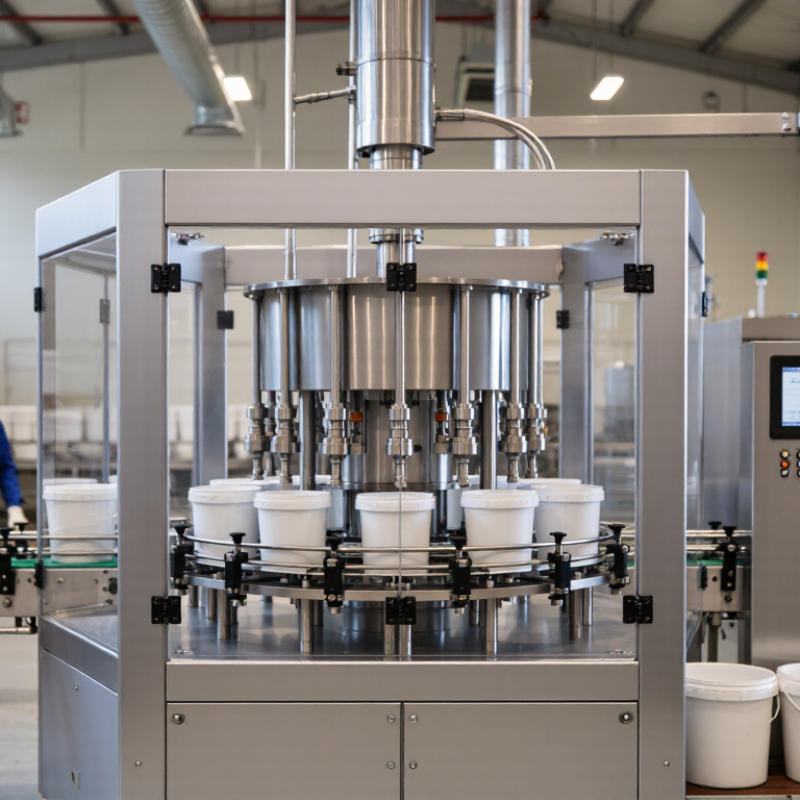
A bucket filling machine is industrial equipment that dispenses a measured quantity of liquid, powder, or viscous material into open buckets. It may use gravity, piston, pump, auger, or net-weight technology. The selected method depends on viscosity, particle size, foam, and required accuracy.
In practice, an operator places empty buckets on a conveyor or filling station. Sensors confirm their position, then nozzles release the product. A programmable controller manages filling speed, volume, and shutoff timing. Net-weight systems can improve consistency, especially for dense coatings or chemicals. According to PMMI’s 2024 State of the Industry report, U.S. packaging machinery sales reached approximately 11.3 billion dollars in 2023. This investment reflects stronger demand for automation and repeatable production.
A suitable machine should also handle bucket diameter, height, lid placement, cleaning, and material compatibility. Stainless steel contact parts are common in hygienic applications. Dust extraction matters when filling dry powders. It is easy to focus on speed. That can be a mistake. Excessive speed may create splashing, foaming, dust, or unstable weights. Grand View Research estimates the broader filling machine market will continue expanding through the decade, driven partly by automated production. Yet laboratory tests do not always match factory conditions. Temperature changes, product settling, and uneven buckets can reduce real-world accuracy. Trial filling remains essential before purchase.
How Bucket Filling Machines Work
A bucket filling machine moves empty containers into a controlled filling position. Sensors confirm each bucket is present and properly aligned. The system then releases product through a measured gate, auger, piston, or weighing hopper. The chosen method depends on the material’s texture, density, and flow behavior. Dry powders may need dust control, while granules often require vibration or adjustable gates. After filling, a checkweigher can identify underfilled or overweight buckets before sealing.
The process sounds simple, but real production is less tidy. Product temperature, humidity, and particle size can change filling accuracy during a shift. In practical commissioning, operators should test several product batches, not just one sample. A stable reading at startup does not guarantee stable performance later. Cleaning access also matters. Residue around sensors or discharge parts can cause inconsistent results and unnecessary downtime.
Tips: Keep the product path clean and inspect sensors daily. Set the target weight after observing actual product flow. Avoid excessive vibration, which may compact some materials. Record fill weights at regular intervals. Small adjustments often work better than aggressive settings. If accuracy remains unstable, review the product itself before blaming the machine.
| Machine Type | How It Works | Typical Product Form | Common Fill-Weight Range | Typical Speed Range | Best-Fit Applications | Key Advantages | Main Considerations |
|---|---|---|---|---|---|---|---|
| Net Weigh Filler | Weigh hoppers are filled to a programmed target weight, then discharge the measured product into the bucket. | Dry, free-flowing products such as grains, seeds, pellets, powders, and granules | Approximately 1–25 kg per bucket, depending on the product and equipment configuration | Approximately 5–25 buckets per minute | Products that require controlled weight and repeatable portioning | Accurate target-weight control and easy recipe adjustment | Product flow characteristics, hopper size, and vibration settings affect performance |
| Gross Weigh Filler | The empty bucket is positioned on a weighing platform and filled directly until the programmed gross weight is reached. | Granular, powdered, and moderately flowable products | Approximately 2–25 kg per bucket | Approximately 4–18 buckets per minute | Medium- and large-format buckets where direct weighing is preferred | Suitable for larger containers and a broad range of fill weights | The filling cycle normally requires the bucket to remain stable on the scale |
| Volumetric Cup Filler | Adjustable measuring cups collect a set volume of product and discharge it into the bucket. | Uniform, free-flowing dry products | Approximately 100 g–5 kg per bucket, depending on cup volume and product density | Approximately 10–40 buckets per minute | High-speed packaging when density remains relatively consistent | Fast operation and straightforward mechanical adjustment | Weight accuracy changes when product bulk density varies |
| Auger Filler | A rotating screw conveys a controlled quantity of product from a hopper into the bucket. | Powders, fine granules, and cohesive dry materials | Approximately 50 g–10 kg per bucket | Approximately 5–30 buckets per minute | Flour, spices, minerals, chemicals, and other powdered products | Good control of dusty and less-free-flowing powders | Screw design, powder aeration, and dust extraction must be matched to the product |
| Linear Weigher | Multiple weighing hoppers combine selected portions to reach the programmed target before discharging into the bucket. | Granules, snacks, seeds, dried food, and irregular free-flowing products | Approximately 100 g–5 kg per bucket | Approximately 10–35 buckets per minute | Products that benefit from multi-hopper weighing and flexible portion sizes | Flexible configuration with good accuracy for many dry products | More weighing stations increase system complexity and cleaning requirements |
| Liquid or Paste Filler | A pump, piston, or timed valve dispenses a measured volume or weight of liquid or paste into the bucket. | Liquids, viscous sauces, creams, gels, and pastes | Approximately 100 ml–20 L per bucket | Approximately 5–25 buckets per minute | Paints, coatings, oils, detergents, food products, and construction compounds | Handles products that cannot be conveyed by dry-product filling systems | Viscosity, temperature, foaming, drip control, and sanitation determine the correct filler design |
| Semi-Automatic Bucket Filler | An operator places and removes buckets while the machine performs metering and filling automatically. | Dry, liquid, or paste products, depending on the filling mechanism | Approximately 1–25 kg or 1–20 L per bucket | Approximately 3–12 buckets per minute | Small- and medium-volume production, frequent product changes, and flexible packaging lines | Lower initial investment and easier adaptation to different bucket sizes | Output depends on operator consistency and manual bucket handling |
| Fully Automatic Bucket Filling Line | Conveyors index empty buckets through filling, optional settling, lid placement, sealing, labeling, and discharge. | Dry products, liquids, pastes, and other products with a compatible filling module | Approximately 1–25 kg or 1–20 L per bucket | Approximately 10–40 buckets per minute | Continuous production with standardized buckets and integrated downstream packaging | Reduced manual handling and consistent line throughput | Requires more floor space, controls integration, changeover planning, and maintenance |
| Sanitary Stainless-Steel Filler | Product-contact parts are designed with cleanable surfaces, hygienic welds, and reduced product-retention areas. | Food, pharmaceutical, cosmetic, and other hygiene-sensitive products | Application-dependent; commonly 100 g–25 kg or 100 ml–20 L | Application-dependent; commonly 5–30 buckets per minute | Facilities requiring frequent cleaning, traceability, or sanitary production practices | Improved cleanability and compatibility with hygienic processing requirements | Sanitary design, washdown protection, validation, and material compatibility may increase cost |
2026 Top Bucket Filling Machine Manufacturers?
Key Criteria for Comparing Manufacturers in 2026
Choosing a bucket filling machine manufacturer requires more than comparing catalog prices. Real production experience matters. Ask how the machine handles your bucket sizes, product texture, filling range, and daily output. A factory visit or live video test can reveal details that brochures often hide, such as powder buildup, awkward access panels, or slow changeovers.
Engineering quality should be measurable. Review filling accuracy records, weighing methods, control-system stability, and cleaning procedures. Request test data using your actual product, not a similar sample. Check whether operators can adjust recipes without complicated menus. Small design choices matter. Tool-free parts, clear sensors, and guarded moving areas can reduce downtime and workplace risks.
After-sales support deserves equal attention. Compare installation training, spare-parts availability, response times, and remote diagnostics. Ask for references from facilities with similar production demands. Total ownership cost should include energy use, maintenance labor, consumables, and expected upgrades. No scorecard is perfect. I have seen technically impressive machines perform poorly because staff training was overlooked. A realistic acceptance test, written service terms, and honest discussions about limitations provide stronger protection than impressive promises.
In 2026, leading bucket filling machine manufacturers will compete through accuracy, uptime, and practical engineering. The strongest suppliers understand that every bucket line has different product flow, container shapes, and cleaning requirements. A machine filling thick coating material needs different controls from one handling free-flowing granules. That detail matters.
Experienced manufacturers usually provide clear dosing data, trial reports, and maintenance guidance before installation. Ask for filling tolerance under real production conditions, not only laboratory results. Servo-driven systems can improve repeatability, while stainless steel contact parts support easier sanitation and longer service life. Operators also need readable controls, quick recipe changes, and safe access to pumps, valves, and sensors. Small design choices often decide whether a line runs smoothly at 6 a.m.
Reliability is more than a strong frame. It includes spare-parts planning, remote assistance, training, and documented testing. During factory acceptance tests, check bucket positioning, lid clearance, product residue, and changeover time. A supplier that welcomes these questions shows useful confidence. Still, no manufacturer is perfect. Some impressive machines may require more skilled maintenance than expected. Others may promise fast delivery but provide vague service coverage. Buyers should record these weaknesses, compare evidence, and request written commitments before approval. A careful evaluation creates fewer surprises after installation.
Selecting the right bucket filling machine manufacturer starts with your product, not a sales presentation. Define bucket volume, powder flow, density variation, target speed, and acceptable weight tolerance. A 25-kilogram mineral powder behaves differently from granular food ingredients. Request test results using your actual material. Polished demonstrations can mislead.
Industry demand supports careful automation decisions. PMMI’s 2023 State of the Industry report valued U.S. packaging machinery shipments at approximately $10.2 billion in 2022. Its findings also identified labor availability and automation as continuing investment drivers. Ask whether the manufacturer can provide documented accuracy, changeover time, dust control, and machine availability data. Look for factory acceptance testing, operator training, spare-parts planning, and responsive regional service. Cheap equipment becomes expensive when one sensor stops production.
Compliance and reliability need equal attention. Check hygienic design, cleanability, guarding, electrical documentation, and applicable local standards before signing. ISO 9001 certification is useful, but it does not prove filling accuracy. Request customer references with similar materials and production volumes. A strong supplier should explain limitations clearly. That matters. I would question any supplier promising perfect results without discussing moisture, particle size, or settling changes. The selection process is not flawless; test samples may not represent every seasonal condition. Build realistic tolerances, measure performance during site acceptance, and keep critical components available for the machine’s operating life.