#4 – 20133 102nd Avenue, Langley, B.C. V1M 4B4 Canada

#4 – 20133 102nd Avenue, Langley, B.C. V1M 4B4 Canada
China’s brushcutter parts market serves repair shops, distributors, and equipment brands worldwide. Choosing a supplier takes more than comparing prices. Buyers need dependable fit, consistent materials, clear specifications, and responsive support. A replacement clutch drum may look correct in a photograph, yet differ in dimensions or tooth profile. Small mismatches can cause delays at the workbench.
This introduction to China’s top 10 Brushcutter Spare Parts suppliers will compare practical factors, including product range, manufacturing experience, quality checks, customization options, lead times, and communication. It will also consider whether suppliers provide useful drawings and fitment guidance. These details matter when sourcing blades, trimmer heads, carburetors, filters, and other frequently replaced components. Not every supplier will suit every buyer. A small repair business may value low minimum orders, while a distributor may need steady stock and predictable delivery. Rankings can guide research, but they cannot replace sample testing or direct verification.
As an illustrative, fictional industry specialist, service engineer Daniel Reed offers this reminder: “A part is only reliable when its fit, finish, and supply history are all checked.” This is an editorially created quotation, not a verified published statement. Use it as a buying principle, not as independent evidence. Compare specifications carefully, request relevant quality documentation, and confirm terms before placing an order. A supplier’s website can answer some questions. It cannot prove every claim.
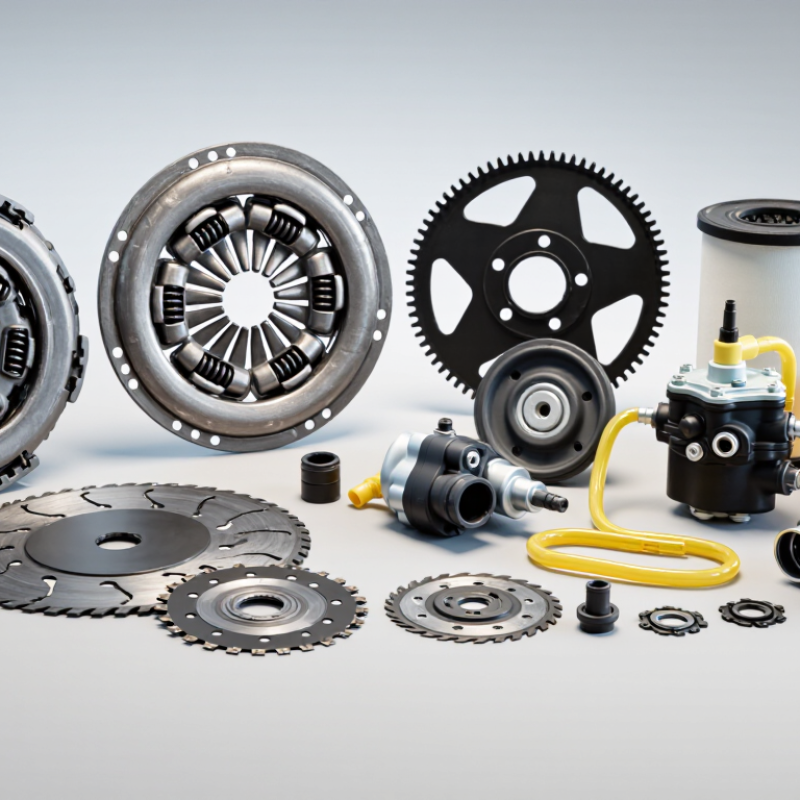
Brushcutter spare parts are replacement components that restore cutting performance, power transfer, or safe handling. A practical classification groups them by function. Cutting parts include blades, nylon-line heads, and trimmer line. Drive components include the clutch, drive shaft, and bevel gearbox. Engine-related parts cover air filters, spark plugs, fuel lines, and carburettor components. Guards, handles, harnesses, and switches support control and protection. Fit matters.
Parts within one group are not automatically interchangeable. Check shaft diameter, spline count, thread direction, mounting bore, and engine specifications before ordering. ISO 11806-1 sets safety requirements for portable brushcutters and grass trimmers, making guards and control components more than cosmetic accessories. The Grand View Research lawn mower market report valued that adjacent equipment market at USD 30.4 billion in 2023; it does not measure brushcutter spare parts specifically, but it shows the scale of outdoor power equipment demand. Classification is helpful, yet imperfect: a gearbox may be sold as an assembly or as separate gears, depending on the service design. A clear parts list should state dimensions and compatibility, not just a component’s name.
China’s brushcutter parts supply chain is layered, not a single factory lane. Specialist makers often produce engine components, carburetors, shafts, cutting heads, guards, filters, and ignition parts. Assemblers and trading companies then combine these items for export orders. This structure gives buyers choice, but each handoff can blur responsibility for fit and finish. A 26 mm shaft may look standard; its coupling and length still matter.
When comparing ten suppliers, map each one to its actual role. A factory may control machining yet outsource springs, seals, or packaging. An exporter may offer a broader catalog, though not direct control over production. Request dimensioned drawings, material details, sample parts, and batch inspection records before ordering. Check that replacements match the exact engine model and production revision. Supplier webpages rarely show the whole story. That gap matters.
Tips: Send a worn sample with clear measurements and photos. Ask the supplier to mark critical tolerances and confirm them on a pre-shipment sample. Keep the first order small; it may slow purchasing, but can reveal poor fit before a full shipment.
This chart groups common brushcutter parts by function, illustrating how the supply chain can be organized around cutting attachments, engine and fuel components, drive and transmission parts, and controls and structure. Values count the representative parts listed for each group; they do not represent supplier numbers, market shares, or production volumes.
A reliable brushcutter spare parts supplier should make compatibility easy to verify. Start with fit. Check part numbers, shaft dimensions, mounting patterns, and model-year details before comparing prices. A clutch drum that looks correct may still have the wrong bore size. Ask for dimensioned drawings or clear photographs when specifications are incomplete. They should be. Measurements matter.
Material and quality controls deserve close attention. For cutting components, ask about steel grade, heat treatment, and inspection procedures. For plastic housings, check wall thickness and resistance to heat and vibration. Request sample parts when practical, then inspect the finish, edges, and fit during assembly. A polished appearance alone proves little. Reliable suppliers should also explain how they handle production checks, defects, and replacement claims.
Check whether stock information is current, and ask for realistic lead times for both common and less frequent parts. Clear packaging labels, batch records, and written compatibility guidance help prevent workshop delays. Technical support matters when a part does not match the machine as expected. No checklist catches every issue; even experienced buyers can overlook a small dimensional difference. Compare evidence, not promises, and keep records of sample tests and supplier responses.
Use this evaluation matrix to compare suppliers without relying on supplier names or unverified rankings. The weights below are a suggested scoring model, not an industry-wide standard. Verify claims using current documents, samples, and order records.
| No. | Evaluation criterion | Suggested weight | Evidence to verify | Useful comparison data |
|---|---|---|---|---|
| 1 | Quality management | 15% | Current quality-system certificate, if claimed; certificate scope and validity; inspection procedures and corrective-action records. | Audit findings, nonconformity records, and documented actions taken to prevent repeat defects. |
| 2 | Part compatibility and fit | 14% | Dimensioned drawings, fitment references, interface measurements, and sample-installation results for the specified equipment models. | Fit-check results, dimensional deviations, and the process for confirming compatibility before production. |
| 3 | Manufacturing capability | 12% | Process list, production equipment, in-process controls, capacity information, and details of any outsourced operations. | Capability by part category, available process controls, and production capacity for the requested order mix. |
| 4 | Materials and process control | 11% | Material specifications, supplier records, and test or treatment records where relevant to the part design and purchase requirements. | Whether material grade, hardness, coating, or other specified properties can be documented and checked by lot. |
| 5 | Product testing and inspection | 10% | Incoming, in-process, and final inspection plans; calibrated measurement equipment records; relevant functional or durability test reports. | Inspection coverage, test method, sample size, acceptance criteria, and retention of results by production lot. |
| 6 | Delivery reliability | 10% | Order confirmations, production lead-time records, shipment documents, and delivery performance for comparable orders. | On-time delivery rate, average lead time, delay frequency, and the supplier's method for communicating schedule changes. |
| 7 | Traceability and documentation | 8% | Lot or batch identification, inspection records, product specifications, and document-retention procedures. | Ability to link shipped parts to production and inspection records and to provide the documents requested for each order. |
| 8 | Export and destination-market requirements | 7% | Product classification, packing and shipping documents, and applicable conformity documentation for the destination and product category. | Document accuracy and ability to identify which legal or technical requirements apply to the specific product and destination. |
| 9 | Technical support and claims handling | 7% | Written warranty terms, complaint procedure, technical contact details, and records of corrective or replacement actions. | Response time, clarity of technical answers, claim resolution time, and availability of replacement parts. |
| 10 | Commercial transparency | 6% | Itemized quotations, minimum order quantities, payment terms, packaging costs, and written change-control terms. | Price consistency, clarity of exclusions, notification of cost changes, and total landed-cost information where available. |
| Total suggested weight | 100% | Adjust weights to match the part type, order risk, and destination-market requirements. | ||
China Top 10 Brushcutter Spare Parts Suppliers
These ten anonymized profiles represent supplier types, not a verified company ranking. Supplier 1 focuses on cutting heads; Supplier 2 stocks nylon line and guards; Supplier 3 makes drive shafts; Supplier 4 supplies gearboxes; Supplier 5 specializes in clutch and starter assemblies. Supplier 6 offers air filters and carburetor components; Supplier 7 handles ignition parts; Supplier 8 produces handles and vibration-control mounts; Supplier 9 supplies blades and fasteners; Supplier 10 combines several part categories with export packing. Their practical differences show up in fit, material consistency, and how clearly they document compatible models.
ITC Trade Map and UN Comtrade provide trade values and quantities under HS 8467, covering multiple hand-held motor tools and parts. The category does not isolate brushcutter spares, so trade totals cannot confirm a supplier ranking. Ask for dated quotations, drawings, sample measurements, and inspection records instead. A polished catalog is not proof of a reliable fit. Some suppliers may also have uneven stock across seasons.
Tips: Measure the shaft, thread, and mounting points before ordering. Request a small sample batch, then check fit and finish against a working unit.
Supplier comparison starts with fit, not price. Check shaft diameter, spline count, mounting-hole spacing, thread pitch, and rotation direction against the original part. For blades, confirm the bore size and permitted dimensions. A difference of a few millimeters can cause vibration or prevent installation. Ask suppliers for a dimensioned drawing, material grade, and inspection records. Then compare these details with your machine’s manual or a measured sample.
Market figures provide context, not a compatibility shortcut. Grand View Research estimated the global lawn mower market at USD 32.08 billion in 2023, with projected annual growth of 5.7% from 2024 to 2030. This is a neighboring equipment category, not a brushcutter-parts market. Still, it signals a broad demand for outdoor power equipment—and many parts listings use inconsistent names. Ask each supplier to map its part number to your model and engine type. Request a sample before placing a large order.
Check sample fit in a controlled setting. Note any wobble, excess play, or difficult threading. Request batch-level inspection results and clarify how defects are handled. A quality certificate helps, but it cannot prove that a specific replacement part fits your unit. I would verify one detail twice: catalog descriptions can be vague. A supplier who answers with measurements is more useful than one who only promises “universal fit.”