#4 – 20133 102nd Avenue, Langley, B.C. V1M 4B4 Canada

#4 – 20133 102nd Avenue, Langley, B.C. V1M 4B4 Canada
Choosing a machine safety door manufacturer is not just a sourcing task. It affects safe access, production uptime, and maintenance work. Global buyers need more than a polished catalog. They need evidence that a door fits the machine, the work process, and the conditions where it will operate.
Safety researcher James Reason wrote, “We cannot change the human condition, but we can change the conditions under which humans work.” That idea matters when selecting guarding. A well-designed door can help separate people from moving equipment, while an unsuitable one may create awkward access or complicate routine checks. Buyers should compare door construction, viewing panels, hinges, interlocks, cycle ratings, and integration support. Ask for drawings, test information, and clear installation guidance. Small details matter.
This guide introduces leading Machine Safety Door manufacturers for global buyers and outlines what to assess before requesting a quote. It considers product range, customization, technical support, delivery capability, and documentation—not just price. Confirm that the proposed design suits the machine and the applicable requirements in its destination market. A supplier’s reputation is useful, but it cannot replace project-specific review. No shortlist is perfect. Product pages may leave practical questions unanswered, and a sample door may not reveal every maintenance issue. That is worth remembering. Compare evidence, ask direct questions, and involve the people who will install and use the door.
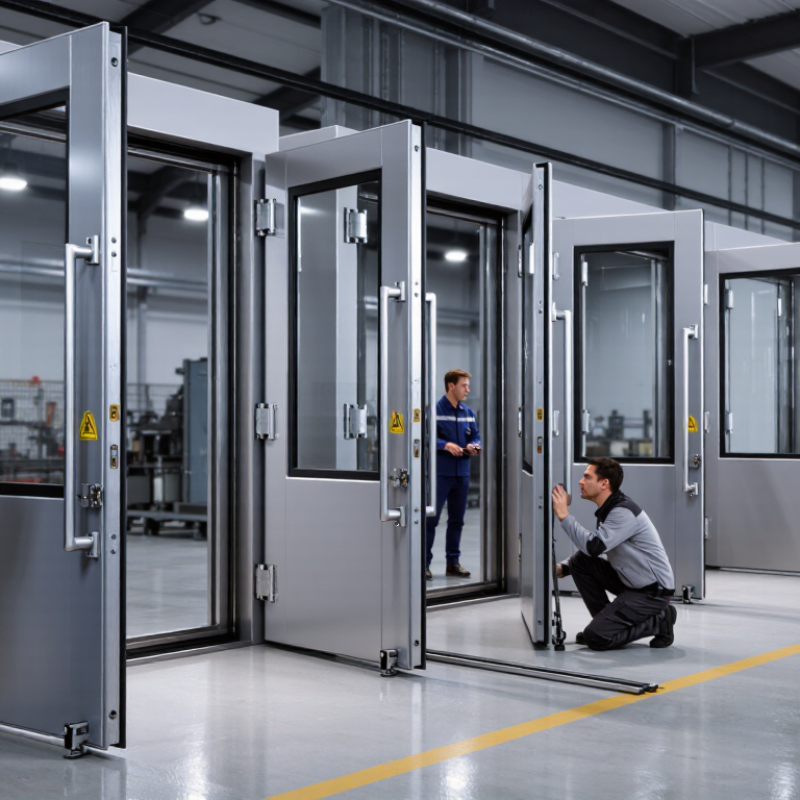
Machine safety doors are movable guards that separate people from hazardous motion while allowing access for loading, cleaning, and maintenance. They are common around robotic cells, CNC machines, packaging lines, and presses. A door may use an interlock that signals equipment to stop when opened. Its effectiveness depends on the full system, including stopping time, access points, and control design. ISO 14120 covers guard design; ISO 14119 addresses interlocking devices associated with guards.
The scale of workplace risk is substantial. The International Labour Organization’s 2019 report, Safety and Health at the Heart of the Future of Work, estimated 2.78 million work-related deaths and 374 million non-fatal work injuries worldwide each year. These figures cover many hazards, not machine doors specifically. Still, they underline why guarding deserves careful attention. A door can look secure yet leave a reach-through gap; rushed reviews can miss it. Small gap. Not harmless.
Tips: Check whether the door withstands expected impact and whether operators can reach hazards before motion stops. Test interlocks during commissioning and planned maintenance. Keep a record of test results. Also consider real working conditions: gloves, oil, vibration, and frequent changeovers can affect use. A technically sound door may still be bypassed if it makes routine tasks awkward. That possibility deserves honest review.
| Safety Door Configuration | Typical Industrial Applications | Common Design Features | Selection Considerations | Relevant Safety Guidance |
|---|---|---|---|---|
| Sliding safety door | Robotic cells, packaging lines, machining centers, and production areas with limited swing clearance. | Door panel runs along a track; may use an interlocking device and a position-monitoring safety switch. | Check available side space, panel travel, resistance to impact, and whether the opening needs to accommodate equipment or materials. | Fixed and movable guards are addressed by ISO 14120; interlocking devices are addressed by ISO 14119. |
| Hinged safety door | Machine enclosures, inspection access points, and smaller guarded work areas. | Opens on hinges and can be fitted with an interlock; a guard-locking device may be needed when hazardous motion takes time to stop. | Account for swing clearance, hinge durability, access frequency, and the machine’s stopping time. | ISO 14119 covers the selection and application of interlocking devices associated with guards. |
| Vertical-lift safety door | Presses, automated loading stations, and cells where floor space for a swinging or sliding door is restricted. | Panel travels vertically and may include counterbalancing or guided lifting components, plus safety interlocking. | Assess overhead clearance, panel weight, guided travel, safe maintenance access, and protection against unintended movement. | The guard and its associated safety functions should be assessed as part of the machine risk assessment. |
| Roll-up or high-speed door | Automated material-transfer openings and production zones requiring frequent passage. | Flexible or sectional curtain opens vertically; the system may include presence detection and safety-related control functions. | Verify that the door is suitable for the machine hazard; consider opening speed, traffic flow, visibility, and how access is safely controlled. | A fast-closing door is not a substitute for a suitable machine guard or a properly designed safety system. |
| Interlocked access door | Enclosed robotic systems, automated assembly lines, and machinery requiring routine operator access. | Opening the guard initiates a defined safety response; guard locking can prevent access until a hazardous condition has ended. | Choose the interlocking approach based on risk, stopping time, access needs, and the required safety performance of the control system. | ISO 14119 provides guidance on interlocking devices; ISO 13849-1 and IEC 62061 address safety-related control systems. |
| Transparent-panel safety door | Inspection zones, packaging equipment, and automated cells where process visibility is useful. | Uses a transparent panel, such as suitable polycarbonate, within a framed guard; the complete assembly must provide the required protection. | Consider impact resistance, chemical compatibility, visibility, panel retention, and replacement requirements. | ISO 14120 sets general requirements for the design and construction of guards; material choice depends on the application. |
| Heavy-duty perimeter access door | Large robotic cells, heavy manufacturing equipment, and guarded production-line perimeters. | Robust framed construction with an access opening, suitable hinges or tracks, and safety devices integrated with the machine controls. | Evaluate guard height and openings, foreseeable impact, access routes, emergency egress, and maintenance procedures. | ISO 14120 covers general guard design and construction; applicable local regulations and machine-specific standards should also be checked. |
Note: Standards listed are guidance references, not a declaration that any particular door or machine is compliant. Final selection and validation should follow a machine-specific risk assessment and applicable local requirements.
When evaluating machine safety door manufacturers, ask for evidence, not polished claims. The ILO’s 2023 global estimates report
2.93 million work-related deaths and 395 million non-fatal work injuries each year. These figures are not specific to machine doors, but they underline why guarding deserves careful review. Check whether the design aligns with relevant standards, including ISO 14120 for guards and ISO 14119 for interlocking devices.
Look closely at the details operators will use every shift. Does the door resist expected impact, stay aligned after repeated opening, and prevent access to hazardous motion? Request test records, material specifications, and documented validation of safety functions. Confirm that the interlock suits the machine’s stopping time; a door that opens before motion stops can leave a serious gap in protection. Ask how the supplier handles replacement parts and technical support across your operating regions.
Scale matters. Check lead times, installation guidance, and whether the door can fit your floor layout without creating awkward workarounds. A sample door or factory acceptance test may reveal loose hinges, poor visibility, or a latch that is difficult with gloves. Paperwork helps, but it cannot reproduce every site condition. That part is easy to underestimate. Compare suppliers using the same criteria, then record any assumptions that still need checking.
Leading machine safety door manufacturers generally fall into three groups: modular guarding specialists, access-interlock suppliers, and custom automation integrators. Modular specialists offer mesh or clear-panel doors that fit standard fence systems. Look closely at hinge strength, latch alignment, and replacement-panel availability. Small details matter on a busy production floor.
Interlock suppliers focus on monitored access, helping prevent hazardous machine motion while a door is open. Custom integrators can adapt door size and layout to robotic cells, conveyors, or tight maintenance spaces, though bespoke designs may take longer to validate.
A useful benchmark is the U.S. Bureau of Labor Statistics’ 2023 Census of Fatal Occupational Injuries, which recorded 5,283 fatal work injuries across all industries. This figure is not specific to machine guarding, so it should not be presented as proof of door performance. Buyers can compare designs against ISO 14120 for guards and ISO 13849-1 for safety-related control systems, then request test records and maintenance guidance.
Ask how the door behaves after repeated slamming, coolant exposure, or a misaligned latch. Those conditions are easy to overlook. A manufacturer’s brochure rarely shows the awkward repair that happens at 2 a.m.; that gap deserves a real conversation.
For global buyers, a machine safety door is more than a panel and latch. Compare sliding, hinged, and lift-up designs against the cell layout, access frequency, and cleaning routine. The International Federation of Robotics reported 4.28 million industrial robots operating worldwide in 2023, in its World Robotics 2024 report. As automation grows, guarding must fit real production tasks—not just a catalog drawing. Ask manufacturers for clear specifications on opening dimensions, interlocks, materials, and integration with your control system.
Customization matters when floor space is tight or equipment has unusual access points. Request drawings and confirm mounting details before production. Then check how the supplier handles replacement parts, technical questions, and support across time zones. A wide product range is useful, but it does not guarantee a good fit. I have seen a tidy specification miss the awkward detail: a door that blocks a maintenance path. Review the proposed design with operators and maintenance staff.
Tips: Share photos, measurements, and access requirements early. Ask for spare-part lead times and support contacts in writing. Compare actual response plans, not just promises.
International buyers should define the machine’s hazards before requesting quotations. A door must control access without creating new pinch points or obstructing emergency exits. ISO 14120 covers guard design, while ISO 14119 addresses interlocking devices. ISO 13849-1 helps buyers specify safety-related control systems. The ILO’s 2023 report, A Call for Safer and Healthier Working Environments, estimates nearly three million work-related deaths each year. It also reports 395 million non-fatal work injuries. Small gaps matter. A standard reference alone does not prove that a guard fits a particular machine or production line.
Compare suppliers on more than unit price. Request risk-assessment support, material specifications, inspection records, and clear installation instructions. Check that doors withstand expected impacts, cleaning chemicals, vibration, and repeated opening cycles. Ask how replacement switches and hinges will be supplied across borders. Confirm which regional conformity documents apply at the destination, and verify them with the relevant authority. A certificate can feel reassuring, but it cannot replace checking the installed system. That detail is easy to overlook. Buyers should also review lead times, spare-parts availability, and technical support in the site’s working language. One imperfect point remains: supplier documents may not reflect real operating conditions, so practical commissioning checks still matter.