#4 – 20133 102nd Avenue, Langley, B.C. V1M 4B4 Canada

#4 – 20133 102nd Avenue, Langley, B.C. V1M 4B4 Canada
Gravity conveyors look simple: rollers, a frame, and a gentle slope. Yet a poorly chosen system can stall cartons, waste floor space, or create awkward manual handling. For buyers comparing Gravity Conveyor Manufacturers in 2026, the real test is how equipment performs with their actual loads, layouts, and operating pace.
MHI describes material handling as “the movement, protection, storage and control of materials and products” across the supply chain. John Paxton, MHI’s president and CEO, works within that wider industry context; the quotation here is MHI’s definition, not a personal statement from Paxton. That distinction matters. Reliable purchasing guidance should separate verified information from marketing claims.
Details matter. A light-duty roller line may suit small cartons, while heavier goods can require stronger frames, suitable roller spacing, and carefully planned transitions. Ask manufacturers about load limits, available widths, installation support, replacement parts, and how they assess your product. Request specifications in writing. Then compare them against your real operating conditions.
Not just the catalog.
This outline will examine leading manufacturers, their product ranges, and the questions worth asking before a purchase. Rankings can be useful, but they are not universal. A company that fits a high-volume warehouse may not suit a compact packing area. The best choice is the one that fits the job—and still works when the cartons arrive unevenly, the floor space is tight, and the shift is busy.
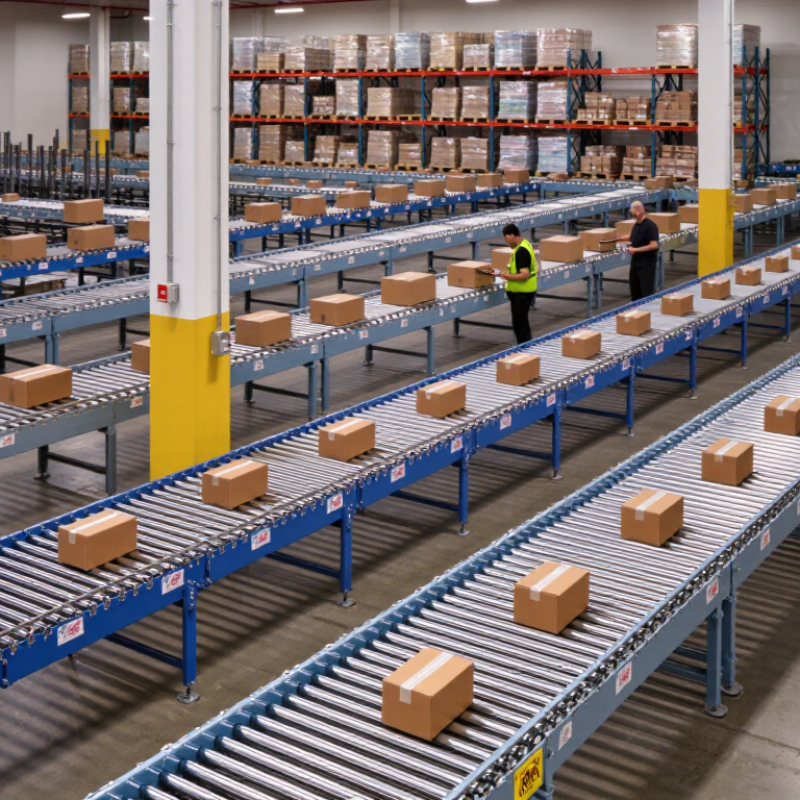
A gravity conveyor moves cartons or totes downhill without a powered drive. Its rollers or wheels turn as an operator loads an item, while gravity supplies the motion. The frame is usually set at a slight incline; adjustable legs help match the line to the work area. Simple in principle. Not effortless in practice. Too little slope can leave cartons stranded, while too much speed can cause impacts at the end of the lane.
Roller models suit packages with firm, flat bottoms; skate-wheel designs can handle lighter items but need stable contact. Side guides, brakes, and end stops help control movement, especially where workers transfer loads by hand.
The MHI and Deloitte 2024 Annual Industry Report found that 55% of surveyed supply-chain leaders planned to increase technology investment. That figure describes broader supply-chain priorities, not gravity-conveyor adoption, but it underscores the value of choosing equipment that fits a specific workflow.
Before installation, teams should test real cartons at different loads and slopes. A detail often missed: packaging changes can alter how smoothly a carton travels. The best setting may need adjustment over time.
Evaluating gravity conveyor manufacturers in 2026 starts with your actual operating conditions. Share the heaviest package, its dimensions, bottom surface, and expected hourly volume. A carton that rolls smoothly on a sample track may snag when its base is soft or uneven. Details matter. Ask how the supplier selects roller diameter, spacing, frame strength, and conveyor slope for your products. Request drawings that show loading points, transfers, supports, and access for cleaning. A useful manufacturer will explain trade-offs, not just quote a price.
Check how proposed equipment performs in your space. Ask for a sample test using representative cartons, including the awkward one that tends to catch. Confirm load limits, installation tolerances, wear-part availability, and what maintenance staff should inspect. Ask for relevant project references and clear documentation. Also compare response times and spare-parts arrangements; a simple conveyor can still interrupt work if a roller is unavailable. Don’t accept a vague promise of “custom design” without dimensions, materials, and written performance assumptions. Some requirements may change after a site survey. That is normal, but the changes should be recorded. A glossy specification sheet is not the whole story.
Leading Gravity Conveyor Manufacturers in 2026 are distinguished by practical engineering, not just broad product lists. Their systems move cartons through warehouses, packing areas, and production lines using gravity rather than powered drives. Roller spacing, frame strength, and conveyor angle all affect how smoothly a load travels. Small details matter. A box with a soft base may catch between widely spaced rollers, slowing the line.
Experienced manufacturers help buyers match conveyor sections to real operating conditions. They ask about carton weight, dimensions, daily throughput, and available floor space. Good guidance should include load ratings, connection options, and clear installation requirements. Some projects need straight rollers; others benefit from curved sections, adjustable legs, or skate-wheel tracks. These choices are not glamorous, but they can prevent awkward handling and wasted space.
In 2026, buyers can compare manufacturers by reviewing technical drawings, material specifications, sample testing, and after-sales support. Ask how frames resist wear in busy work areas, and whether replacement rollers are easy to obtain. A polished catalog is useful, but it cannot show every floor-level problem. Even a careful specification may miss a bottleneck that appears only during a full shift. That deserves a second look. Manufacturers who listen, explain trade-offs, and adapt layouts to actual loads offer a more dependable basis for selection.
Gravity conveyor manufacturers commonly supply straight and curved roller sections, skate-wheel tracks, expandable lines, supports, and transfer gates. Some also build chutes and carton-flow lanes. These systems need no powered drive. They suit facilities moving cartons, totes, and stable loads between packing, sorting, and shipping stations. Yet soft bags and uneven package bases can snag or drift.
Products vary by duty. Light-duty rollers serve parcel and apparel operations; heavier rollers handle boxed components and manufacturing buffers. Expandable conveyors fit temporary dock layouts, while fixed lanes suit repeatable routes. Details matter. Roller pitch, frame width, slope, and stops should match the smallest package and heaviest expected load. That check is easy to rush.
The U.S. Census Bureau estimated 2024 retail e-commerce sales at $1.19 trillion, up 8.1% from 2023. This signals parcel-handling demand, not a conveyor-specific forecast. MHI’s 2024 Annual Industry Report found that 55% of surveyed supply-chain leaders expected to increase investment in technology and innovation. Gravity systems can complement automation in distribution, food packaging, automotive assembly, and general manufacturing. Washdown areas may require suitable materials and designs. Not every line needs sensors. Gravity equipment is not maintenance-free: dust, worn bearings, or poor leveling can slow a line, even when installation looks simple.
Choosing a gravity conveyor manufacturer in 2026 starts with the load, not the catalogue. Share the product’s weight, dimensions, base shape, and daily throughput. A carton with a flat bottom behaves differently from a soft bag or narrow tote. Small details matter. Ask for a layout showing conveyor width, roller spacing, slope, and transfer points. These affect whether cartons move smoothly or stall between sections.
Check how the manufacturer selects rollers and frames for your actual operating conditions. Request load ratings and clarify whether they apply to each roller, each section, or the full conveyor. For a sloped line, ask how speed and stopping points will be controlled. A short sample test with your own cartons can reveal wobbling, gaps, or unexpected acceleration. If testing is unavailable, treat that uncertainty seriously.
Reliable support matters after installation, too. Ask about replacement roller availability, installation guidance, and response times for technical questions. Review drawings and specifications before approving a quote, and confirm that site measurements match the proposed layout. A polished brochure is not proof of a good fit. I would also compare several offers on the same requirements; otherwise, a lower price may simply leave important details unspecified. A little friction in the selection process is useful. It can expose assumptions before they become costly changes on the warehouse floor.