#4 – 20133 102nd Avenue, Langley, B.C. V1M 4B4 Canada

#4 – 20133 102nd Avenue, Langley, B.C. V1M 4B4 Canada
Choosing the right Center Joint can significantly affect an excavator’s movement, uptime, and maintenance costs. This component connects hydraulic circuits between the upper structure and the undercarriage. It allows the machine to rotate while oil continues reaching the travel motors. Without a reliable connection, hoses can twist, leak, or suffer premature wear. That problem may appear small. It rarely stays small.
In practical excavator maintenance, technicians examine seal condition, port alignment, pressure ratings, and contamination control. A properly matched Center Joint supports smoother travel and more consistent hydraulic performance. It also helps protect expensive hoses and valves from unnecessary stress. Manufacturer specifications, service records, and operating conditions should guide the selection. A compact excavator working in muddy trenches may need different protection than a mining machine operating in dust and heat. The cheapest option is not always the most economical.
There is no universal center joint for every excavator. Poor installation, incorrect torque, or neglected filtration can still cause failure. This point deserves attention. Regular inspections can reveal oil seepage, unusual rotation resistance, or loosened fittings before serious downtime occurs. Reliable suppliers should provide verified dimensions, material details, pressure data, and technical support. These details build confidence, but they do not replace professional inspection. A careful choice combines machine compatibility, proven design, realistic service needs, and long-term reliability.
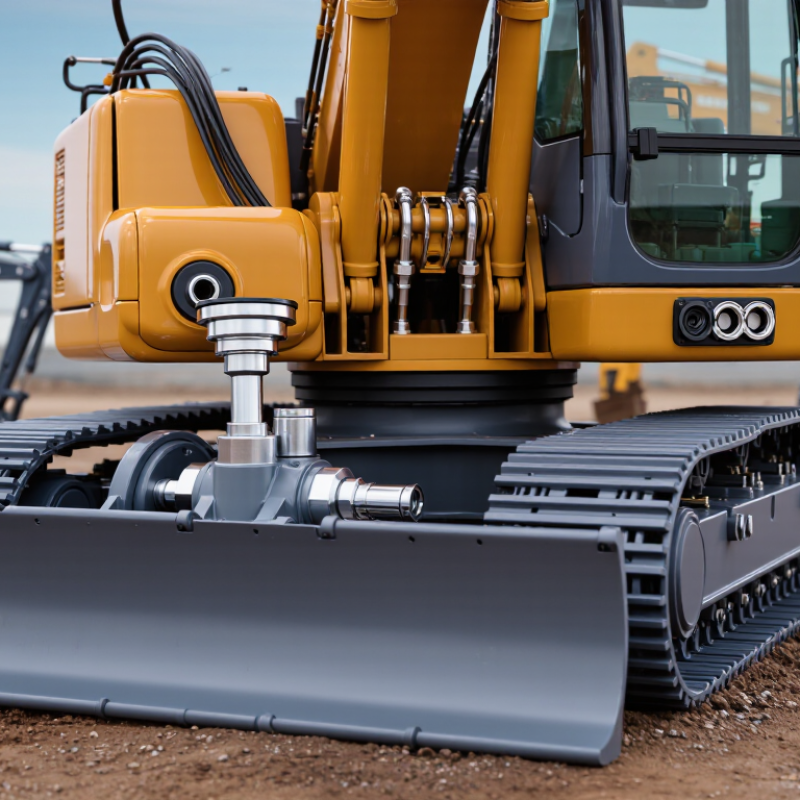
A center joint lets an excavator transfer power while the upper structure rotates 360 degrees. It connects the rotating frame with the undercarriage. Without it, hoses and wires would twist repeatedly. That failure is expensive.
The hydraulic section carries oil for travel motors, blade circuits, and other lower-frame functions. Port size, pressure rating, and internal sealing must match the machine’s working demands. Pilot transfer is equally important. Small pilot lines control larger valve movements, so contamination or leakage can create slow, uneven responses. A clean filter helps, but it cannot repair a worn seal.
Electrical transfer uses rotary contacts or slip-ring assemblies. These components carry power and signals through continuous rotation. They may support travel sensors, safety circuits, and position feedback. Moisture, vibration, and poor grounding can cause intermittent faults. Those faults are often harder to find than a visible oil leak.
The choice is not always clean. A technically correct joint can still fail early after rushed installation. Experienced technicians check port orientation, hose bend radius, connector condition, and bolt torque before operation. They also inspect for heat, metal particles, and gradual pressure loss. A center joint deserves careful testing, not just a quick replacement. Small errors become serious after hundreds of rotations.
Why Choose a Center Joint for Excavators?
Continuous 360° upper-body rotation depends on a reliable center joint. This rotary manifold transfers hydraulic oil, pilot signals, and sometimes electrical circuits between the fixed undercarriage and rotating upper structure. It prevents hoses from twisting during repeated slewing. In field inspections, small seal leaks often appear before major performance loss. The warning can be easy to miss.
The International Construction 2024 Yellow Table recorded 243.4 billion dollars in sales among the world’s 50 largest construction equipment manufacturers in 2023. That scale reflects intense equipment utilization and tougher demands on hydraulic components. Off-Highway Research’s 2024 market review also identifies hydraulic excavators as a core equipment segment across major regions. More working hours mean more rotation cycles, contamination exposure, and thermal stress.
A good center joint maintains stable flow during digging, loading, and trenching. Its internal passages must limit pressure loss while resisting abrasive particles. Clean hydraulic oil matters. So does correct seal selection for temperature and pressure changes. During maintenance, technicians should check rotation smoothness, leakage, drain-line pressure, and mounting bolts. Ignoring the drain circuit can damage seals prematurely. I have seen operators blame the swing motor when the real issue was a restricted center-joint passage. The component is compact, but not simple. Its service life depends on design, installation, oil cleanliness, and operating habits. Not every failure is dramatic.
A hydraulic center joint transfers oil between the stationary undercarriage and the rotating upper body. This arrangement keeps travel, swing, and auxiliary hydraulic circuits connected while the excavator rotates continuously through 360°.
The chart shows representative swing-speed ranges commonly specified for different excavator classes. Actual performance varies with machine configuration, operating conditions, and hydraulic system design. The center joint enables continuous rotation by preventing hydraulic hoses from twisting during repeated full-circle operation.
Pressure and flow matching decide whether an excavator works smoothly at 20–35 MPa. A center joint transfers hydraulic oil between the upper structure and undercarriage while the machine swings. Its internal passages must match pump flow, pressure peaks, and return-line backpressure. A mismatch creates heat, sluggish travel, or seal damage. ISO 4413:2010 requires hydraulic systems to control pressure, leakage, and stored energy. That standard supports a practical rule: select the joint from measured operating data, not housing size alone.
Field experience shows why this matters. A 25 MPa system may experience higher transient pressure during sudden travel stops. Flow can also exceed the nominal value during combined functions. The International Energy Agency reports that hydraulic systems can lose significant energy through throttling and pressure drops. The exact loss depends on design and duty cycle. A center joint with undersized passages may feel acceptable during inspection, then heat the oil after hours of trenching. I have seen this assumption fail.
Tips: Record maximum pressure, average flow, port size, oil temperature, and swing speed. Compare these values with the joint’s continuous and peak ratings. Check rotation torque at cold start. Small details matter. Allow for contamination control and seal compatibility. Recheck the calculation after attachment changes, because a larger breaker or bucket can alter flow demand. One uncertainty remains: catalogue ratings may use different test conditions, so direct supplier verification is still necessary.
Reliability Factors: Seal Design, Filtration, Leakage, and Service Life
A center joint transfers hydraulic oil while the upper structure rotates smoothly. Its reliability begins with seal design. Properly sized seals must tolerate pressure changes, temperature shifts, and repeated rotation. The sealing surfaces also need accurate machining. Even a small scratch can create a slow, costly leak.
Clean oil matters just as much. Fine particles can damage sealing lips and wear internal passages. A practical maintenance routine includes checking filter condition, sampling hydraulic oil, and keeping open ports covered during service. Field inspections often reveal neglected contamination. It is easy to blame the joint first, but dirty oil may be the real cause.
Leakage usually appears gradually. Look for dampness around the joint, oil trails on the frame, or a falling reservoir level. A pressure test can confirm whether the problem is internal or external. Do not ignore early signs. They rarely improve.
Service life depends on alignment, installation quality, operating load, and maintenance records. A durable center joint still needs correct torque and clean assembly. I have seen new seals fail because technicians rushed the installation. That mistake is preventable. Yet inspection routines are not perfect, and service intervals may need adjustment after harsh, dusty work. A reliable choice is one supported by measurable test data, clear maintenance instructions, and seals suited to the excavator’s actual working conditions.
Why Choose a Center Joint for Excavators?
A center joint keeps hydraulic flow moving between the upper structure and undercarriage during continuous slewing. Selection starts with port count. Match every travel, pilot, drain, and auxiliary circuit. One missing port can force external hoses, increasing exposure to abrasion and twisting. I have seen compact excavators lose reliability because a joint had the right appearance but the wrong circuit layout.
Bore size must follow measured flow, not guesswork. Undersized passages increase pressure loss and heat. Oversized passages may add cost and unnecessary weight. Compare the joint’s rated flow with the pump’s peak demand, then check pressure during simultaneous travel functions. Excavator tonnage matters too. A larger machine creates higher structural loads and often uses larger hydraulic circuits. The joint should meet working pressure, peak pressure, rotational speed, and load requirements for that class. A simple tonnage match is not enough.
Cleanliness deserves equal attention. ISO 4406:2017 classifies fluid by particle counts above 4, 6, and 14 micrometres. For example, ISO 18/16/13 permits roughly 1,300–2,500 particles above 4 micrometres per millilitre, according to the standard’s coding ranges. That is not clean by visual inspection. Use capped ports, filtered oil, and laboratory particle counts before installation. A 2023 fluid-power reliability survey linked contamination with a large share of hydraulic failures, although survey methods vary. That limitation matters. Pressure-test the assembled system, record the cleanliness code, and recheck after commissioning. Hidden contamination is easy to underestimate.
| Selection Criterion | Typical Data Range | What the Specification Controls | Practical Selection Guidance | Key Verification Point |
|---|---|---|---|---|
| Port Count | 2 ports 3 ports 4 ports 5 or more ports | The number of hydraulic passages available through the rotating center joint. It determines how many independent circuits can pass between the upper frame and the travel motors. | 2 ports: Common for basic travel circuits. 3–4 ports: Suitable when an additional pilot, brake-release, drain, or auxiliary circuit is required. 5+ ports: Used when several independent functions must pass through the joint. | Count the required circuits, including case-drain and brake-release lines where applicable. Do not select by port count alone; each passage must also meet the required flow and pressure. |
| Nominal Bore Size | 8–12 mm 13–18 mm 19–25 mm 26–32 mm 33–40 mm | The internal passage diameter affects flow capacity, pressure loss, fluid velocity, heat generation, and connection compatibility. | Smaller bores may be appropriate for pilot or low-flow circuits. Medium bores are commonly considered for travel-motor working lines. Larger bores are generally required for high-flow hydrostatic circuits or larger excavators. | Match the bore to the required continuous and peak flow. A larger bore does not compensate for an incorrectly sized port, seal, bearing, or housing. |
| Excavator Operating Weight | 1.5–6 tonnes 6–15 tonnes 15–30 tonnes 30–50 tonnes Over 50 tonnes | Operating weight provides an initial indication of travel-motor size, expected tractive load, hydraulic flow, pressure, and center-joint structural requirements. | Compact machines usually require smaller passages and lower flow capacity. Medium and large excavators typically require higher pressure ratings, larger passages, stronger bearings, and greater resistance to shock loading. | Tonnage is only a screening parameter. Confirm the actual travel-motor displacement, system pressure, maximum flow, machine speed, and duty cycle before final selection. |
| Working Pressure | 210–250 bar nominal 250–315 bar nominal Up to approximately 350 bar peak, where specified | Pressure rating defines the maximum allowable hydraulic load on the body, passages, seals, threaded connections, and rotating interfaces. | Select a center joint with a continuous pressure rating above the machine's normal operating pressure and a peak rating that covers transient pressure spikes. | Compare both continuous and peak ratings. Pressure capability must be evaluated together with temperature, fluid type, speed of rotation, and expected shock loads. |
| Required Flow Rate | Pilot circuit: typically below 20 L/min Low-flow auxiliary circuit: approximately 20–60 L/min Travel circuit: commonly 60–200+ L/min per passage | Flow capacity determines pressure drop and fluid velocity through the center joint. Insufficient capacity can reduce travel performance and increase heat generation. | Size each passage for the maximum expected flow, not only the average flow. Consider whether flow is continuous, intermittent, bidirectional, or shared between functions. | Use the actual pump and travel-motor flow data. Verify pressure drop at operating temperature and at the maximum expected flow rate. |
| Rotation Speed | Typically below 10 rpm during machine travel Higher transient speeds may occur during steering or track-speed changes | Rotation speed influences seal wear, friction, heat generation, and the permissible combination of pressure and flow. | A center joint for an excavator must tolerate repeated oscillating rotation and frequent directional changes rather than only steady continuous rotation. | Check the manufacturer's speed limits at the intended pressure, temperature, and fluid viscosity. Confirm that the seal material is compatible with the specified hydraulic fluid. |
| ISO 4406 Cleanliness Code | 18/16/13: common reference level for general hydraulic systems 17/15/12: cleaner operating target 15/13/10 or cleaner: used for contamination-sensitive components when specified | ISO 4406 reports the number of particles at or above 4, 6, and 14 micrometres per millilitre. Lower code numbers indicate fewer particles and cleaner hydraulic fluid. | Use the cleanliness level required by the most contamination-sensitive component in the circuit. A clean center joint cannot compensate for dirty oil, contaminated hoses, or poor assembly practices. | Confirm the required code from the complete hydraulic-system specification. Take representative fluid samples using a clean sampling method and maintain filtration, flushing, and sealed storage practices. |
| Connection and Installation Compatibility | Metric or imperial ports Threaded, flange, or hose connections Standard or custom mounting patterns | Connection type, port orientation, mounting dimensions, shaft height, and bolt pattern determine whether the center joint can be installed without hose interference or structural modification. | Select the same connection standards and port locations as the machine's existing hydraulic layout whenever possible. Confirm hose bend radius and access for maintenance. | Check dimensional drawings, port identification, mounting-hole pattern, rotation direction, and the correct orientation of the inner and outer passages before installation. |
| Selection rule: Choose the center joint by evaluating port count, bore size, operating weight, pressure, flow, rotation speed, cleanliness requirements, and installation dimensions together. Excavator tonnage can narrow the search, but the final selection should be based on the machine's verified hydraulic specifications and duty cycle. | ||||