#4 – 20133 102nd Avenue, Langley, B.C. V1M 4B4 Canada

#4 – 20133 102nd Avenue, Langley, B.C. V1M 4B4 Canada
Optimizing the injection moulding process in 2026 requires more than increasing speed or pressure. Manufacturers now balance cycle time, part quality, energy use, recycled content, and process stability. The challenge is practical. A two-second reduction can increase warpage, flash, or rejected parts.
Industry demand remains substantial. Fortune Business Insights estimates that the global injection molding machine market will grow from about USD 20.7 billion in 2024 to more than USD 29 billion by 2032. Plastics Europe reported global plastics production of approximately 414 million tonnes in 2023. These figures show the scale of the sector, but they do not guarantee efficient production. Each factory still depends on its mold design, polymer grade, machine condition, and operator experience.
Reliable optimization begins with measurable evidence. Technicians should record melt temperature, injection speed, holding pressure, cooling time, cushion position, and part weight. Small changes matter. A stable cushion often reveals better shot consistency. Infrared checks can expose uneven mold temperatures before defects become visible. ISO 20430:2020 provides relevant guidance for injection molding machine safety and operational considerations, while structured trials can support repeatable process development. Energy monitoring also deserves attention. The U.S. Department of Energy identifies efficient motor systems, reduced idle time, and improved machine control as practical industrial energy opportunities.
Not every recommended setting works everywhere. That is the uncomfortable part. A high-speed recipe may fail with a recycled resin batch. A lower temperature may save energy but worsen weld-line strength. Therefore, this guide examines proven methods, real production trade-offs, and the measurements needed to improve the injection moulding process without treating perfection as a realistic target.
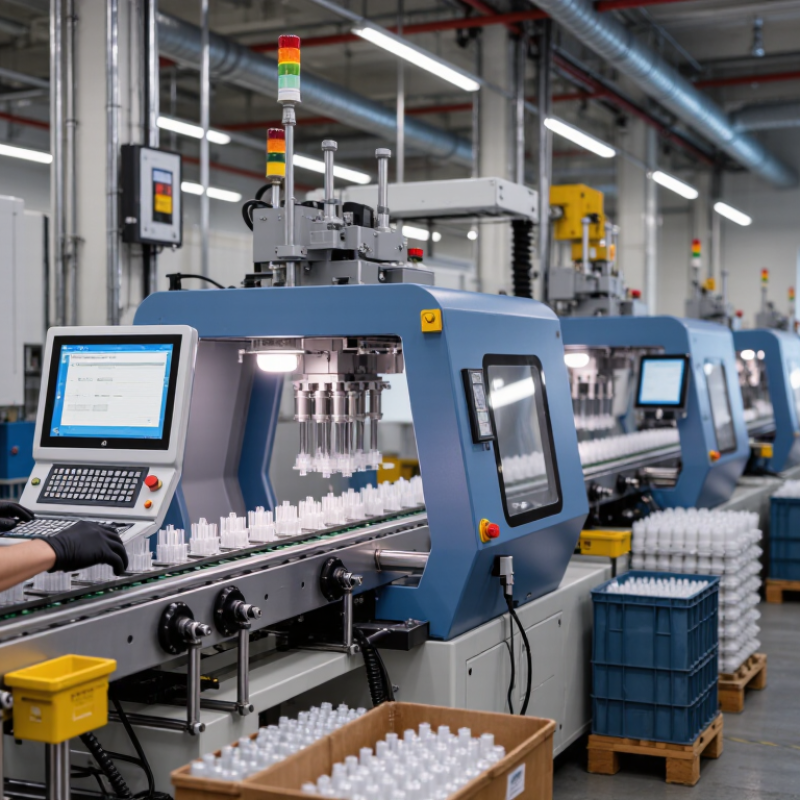
Injection moulding performance in 2026 should be managed through measurable targets, not optimistic estimates.
Set OEE above 85% and scrap below 2% for each critical machine. The OEE Foundation identifies 85% as a world-class reference point, while ISO 22400 supports consistent KPI calculations. Track availability, performance, and quality separately. A machine can show strong uptime while losing output through slow cycles and short stoppages.
The 2024 Global Lighthouse Network report shows that advanced factories have achieved major productivity gains and defect reductions through real-time data and disciplined process control. On an injection moulding line, capture cycle time, melt temperature, mould pressure, cooling time, and reject reason by batch. I have found that drying errors and unstable cooling often create more scrap than dramatic machine failures. That is uncomfortable, but useful. Review the first ten shots after every setup change. Freeze approved parameters. Recheck them after material changes.
Tips:
Start with one high-volume mould. Install automatic shot and reject tracking. Set an hourly OEE board near the machine. Investigate every stoppage longer than five minutes. Use a Pareto chart weekly. Do not hide rework inside “good output”; it weakens the data. Allow operators to challenge targets when measurements are incomplete. Perfect dashboards can still describe a badly controlled process.
How to Optimize the Injection Moulding Process in 2026?
PET demands disciplined preparation before injection moulding. Its moisture content should fall below 0.02%, or 200 ppm, before processing. ISO 15512:2019 provides standard methods for measuring moisture in plastics. In practice, many PET processing guides recommend drying temperatures near 160–180°C, with air dew points around –40°C. Wet pellets can hydrolyze during melting, reducing molecular weight and causing brittle parts, silver streaks, and unstable viscosity. The SPE Injection Molding Handbook identifies drying control as a major factor in PET part quality.
Do not trust dryer settings alone. Verify the actual pellet moisture after drying. Karl Fischer testing gives better evidence than relying on time or temperature. Crystallised pellets may need several hours, while reprocessed PET often requires tighter monitoring because its moisture history is uncertain. A 2024 Plastics Europe report recorded 54.6 million tonnes of European plastics production in 2023, showing the scale of material efficiency challenges. Small drying losses become expensive across high-volume production. I still see operators over-drying PET. That wastes energy and may darken the resin.
Tips: Keep sealed containers near the dryer. Check dew point, airflow, and hopper temperature every shift. Sample pellets from the hopper outlet, not only the storage bag. Record moisture, melt temperature, and reject rate together. If results disagree, question the test method first. Some production teams skip that uncomfortable step.
How to Optimize the Injection Moulding Process in 2026?
A stable cushion protects filling consistency. After injection and holding, keep about 3–10 mm of melt ahead of the screw. Start near 5 mm, then validate the setting with short-shot studies and pressure trends. A cushion below 3 mm can cause pressure loss, incomplete filling, or visible weight variation. Excessive cushion can increase residence time and material degradation. It also consumes usable shot capacity.
Watch the machine display after every cycle. The cushion should return to nearly the same position, not wander several millimetres. Check screw recovery, non-return valve wear, decompression, and melt temperature before changing injection speed. A practical trial uses ten consecutive parts. Record part weight, peak injection pressure, cushion position, and cavity appearance. One unstable signal may be noise. Repeated drift is evidence.
The 2024 PlasticsEurope report placed global plastics production near 414 million tonnes in 2023. Small process losses become significant at that scale. The OECD Global Plastics Outlook reported that only about 9% of plastic waste was recycled in 2019. Better filling control can reduce rejects, although cushion alone cannot solve every defect. It is a starting point, not a universal rule. Sometimes 3 mm works. Sometimes it does not. Material grade, screw geometry, mould design, and machine response still matter. Run the test, question the result, and document the actual window.
How to Optimize the Injection Moulding Process in 2026?
Control Cooling: Hold Mold Temperature Within ±1°C Across Production
In 2026, cooling control remains one of the clearest paths to stable injection moulding. Mold temperature affects shrinkage, warpage, cycle time, and surface quality. A displayed setpoint is not enough. Measure the actual mold surface and cooling circuit temperatures at several points.
Keep the mold within ±1°C during production, not only during startup. Use calibrated sensors near the cavity, core, and hottest areas. Check coolant flow, pressure, and return temperature for every circuit. A partially blocked channel can create a hidden hot spot. Small details matter.
Cold spots appear quickly.
Record temperature data throughout each shift. Compare the first cycle with parts produced several hours later. Changes in workshop temperature, coolant level, or machine load can disturb thermal balance. Insulation around hoses may also reduce unwanted heat gain.
A ±1°C target is useful, but it is not magic. Different polymers may require different mold temperatures and cooling times. Confirm the process window through dimensional checks, weight records, and visual inspection. I have seen teams trust one sensor too much, then discover uneven cooling after repeated defects. That mistake is avoidable, although perfect control is rarely simple.
Review cooling performance after maintenance, material changes, and long production stops. Stable temperature control supports consistent parts and makes other process improvements easier to verify.
In 2026, injection moulding improvements should be proven, not merely reported. A small cycle-time gain can hide higher scrap or unstable dimensions. Design of Experiments (DOE) exposes these trade-offs with fewer trials than one-factor testing. Select measurable responses: part weight, shrinkage, warpage, flash, and cycle time. Factors may include melt temperature, injection speed, hold pressure, and cooling time. Define safe operating limits before testing. That detail is often missed.
Run the DOE on a maintained machine with recorded material condition and mould temperature. Repeat center points to detect drift, not luck. Then confirm the selected window with production-sized samples. Statistical Process Control (SPC) should follow validation. Use control charts for critical dimensions and weight, with rational subgroups taken across shifts. Investigate trends before points breach limits. A capable process is useful, but capability indices do not replace engineering judgment. We have all seen a good Cpk from a poorly chosen specification.
ISO 20430:2020 adds a necessary safety lens. Review guarding, interlocks, access points, and stored-energy hazards when changing settings or tooling. Record who approved each change and which verification was completed. Do not treat a parameter sheet as proof of conformity. A safer control plan links machine safeguards, work instructions, training, and maintenance checks. Keep photographs of sample defects beside the control chart. They make recurring patterns easier to challenge. Some improvements will fail. That is valuable evidence, provided the team documents why, repeats the test, and resists convenient conclusions.